1951
14,763 km²
All Present
Jun – Oct
The Serengeti is Tanzania’s oldest and most celebrated national park — a UNESCO World Heritage Site covering an area the size of Northern Ireland. Its name comes from the Maasai word Siringet, meaning “endless plains,” and the landscape delivers exactly that: a boundless mosaic of golden grassland, acacia woodland, seasonal swamps, and ancient granite outcrops called kopjes.
It is home to the largest terrestrial mammal migration on Earth — a circular journey of 1.7 million wildebeest and 500,000 zebra that follows the rains around a 1,200 km circuit. But the Serengeti is more than the migration. With approximately 3,000 lions, it holds the continent’s highest concentration of the big cats, alongside vast herds of elephants, hundreds of leopards, and over 500 bird species.
The vast short-grass plains of the south are the calving grounds of the wildebeest — over 500,000 calves are born here each January and February. Predator densities are extraordinary during this season as lions, cheetahs, and hyenas follow the herds.
The heart of the Serengeti, Seronera is the most accessible zone and offers year-round wildlife. The Seronera River valley supports resident leopards — famously draped on sausage trees — along with lions, hippos, and large concentrations of resident plains game.
The migration pushes through the Western Corridor between May and July, where the Grumeti River’s enormous resident crocodiles lie in wait. Smaller but equally dramatic than the Mara crossings, the Grumeti crossings are often witnessed in near-solitude.
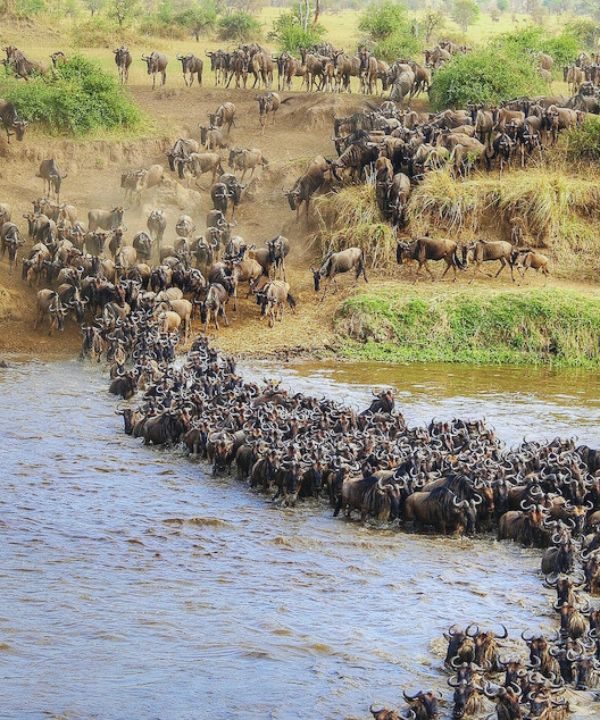
The stage for the most dramatic Mara River crossings, the northern Serengeti draws safari-goers from around the world between July and October. Enormous wildebeest columns thunder toward the crocodile-lined banks in a spectacle that never loses its power.
The Serengeti holds Africa's highest density of these majestic big cats.
The core of the Great Migration, moving in a relentless annual cycle.
Both resident and migratory herds roam the vast acacia woodlands.
The open plains specialist, built for record-breaking speed.
Master of stealth, frequently found lounging in the Seronera valley trees.
Increasingly sighted as conservation efforts bring back these social hunters.
Found in massive pods within river pools and marshy lakes.
A paradise for birders, including local residents and migrants.
Every year, 1.7 million wildebeest and 500,000 zebra embark on a 1,200 km circular journey across the Serengeti–Mara ecosystem — driven entirely by rain and fresh grass. It is the largest overland migration of any mammal on Earth, a relentless cycle of birth, movement, and predation that has played out for millennia.
The most dramatic chapter is the Mara River crossing in the northern Serengeti from July to October, when herds hurl themselves into crocodile-filled waters in a frenzy of noise, dust, and raw survival instinct.
1.7 Million
500,000
~1,200 km
Jul – Oct
The southern plains explode with newborn wildebeest calves — and the predators that follow them.
Green season. Lush landscapes, newborn animals, dramatic skies, and far fewer tourists.
The migration moves north through the Western Corridor. Excellent predator viewing begins.
Peak season. The northern Serengeti's Mara River crossings are at their most dramatic.
Short rains refresh the landscape. The migration begins moving south again. Good birding.
Safari Tours
Safari Tours
Safari Tours
Safari Tours
Safari Tours
Safari Tours